A soybean project teaches the whole cycle of farming: choosing a variety, planting, scouting, harvesting, measuring yield and keeping records. This guide is for 4-H members, FFA students building a Supervised Agricultural Experience (SAE), and the leaders and ag teachers who coach them.
Project ideas by experience level
| Level | Project | What you'll learn |
|---|---|---|
| Beginner | Grow edamame or soybeans in pots or a garden row; keep a plant journal | Growth stages, plant care |
| Intermediate | Variety comparison: 2–4 varieties side by side in a small plot | Maturity groups, traits, fair comparisons |
| Advanced | Replicated demo plot testing seeding rate, row spacing or seed treatment | Experimental design, yield math, economics |
| SAE / business | Rent or borrow a few acres, track every cost and sell the crop | Budgets, break-even, marketing |
How to run a soybean demo plot
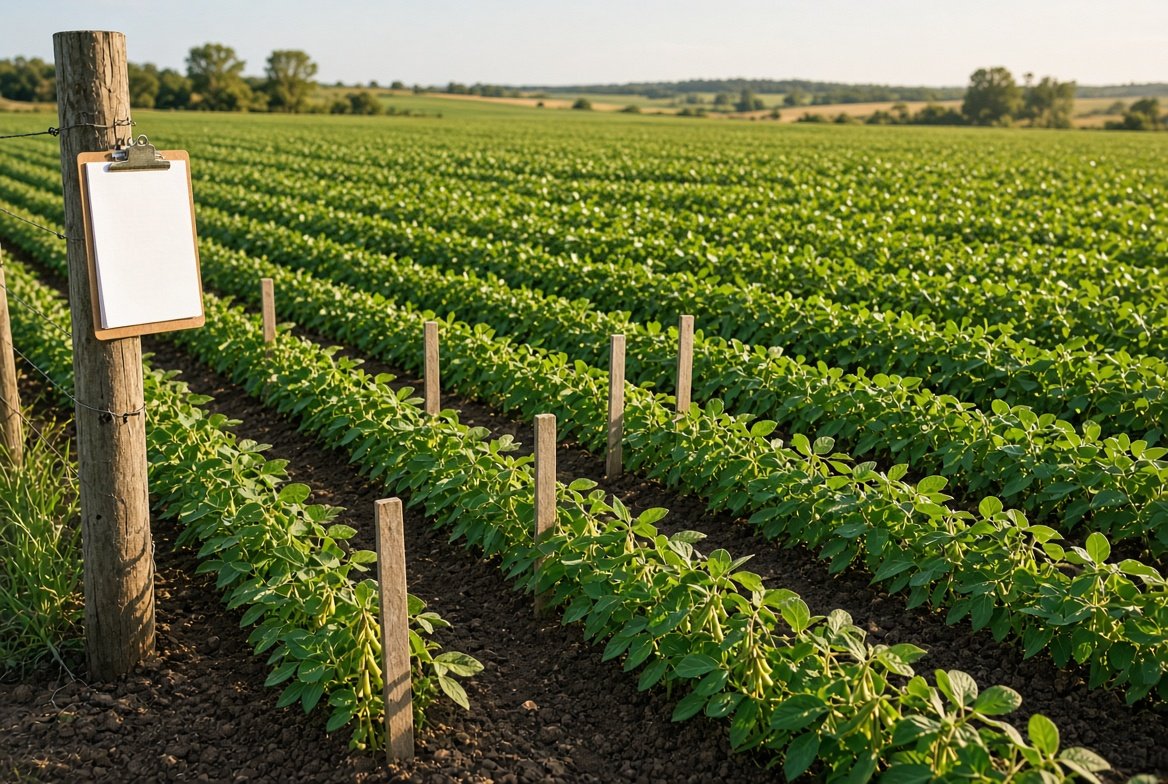
- Ask one question. Example: "Which of these three varieties yields most on our farm?" Change only one thing between strips.
- Lay out strips. For a hand-harvested plot, 4 rows × 20 feet per strip is plenty. Plant each variety or treatment at least twice, in mixed-up order, so one good or bad spot in the field doesn't decide the winner.
- Choose adapted varieties. Use our variety database and variety selector to pick ones that fit your maturity group.
- Plant on the same day at the same depth and seeding rate (try the seeding rate calculator).
- Scout every week. Record stage, weeds, insects and disease. Our disease guide helps identify problems.
- Mark stakes clearly with weatherproof labels and keep a map in your record book.
How to measure yield
Hand-harvest a measured length of row from the middle rows of each strip, thresh or shell the beans, and weigh them.
Square feet = row length (ft) × row width (ft). Example: 20 ft of 30-inch rows = 20 × 2.5 = 50 sq ft. If you harvest 3.6 lb: (3.6 ÷ 60) × (43,560 ÷ 50) = 52.3 bu/acre.
For a fair comparison, let beans dry to about 13% moisture (pods rattle and beans are hard), and average the yields of the two strips of each variety. Then plug your yield into the break-even calculator to see what it means in dollars at today's soybean price.
Exhibiting soybeans at the county fair
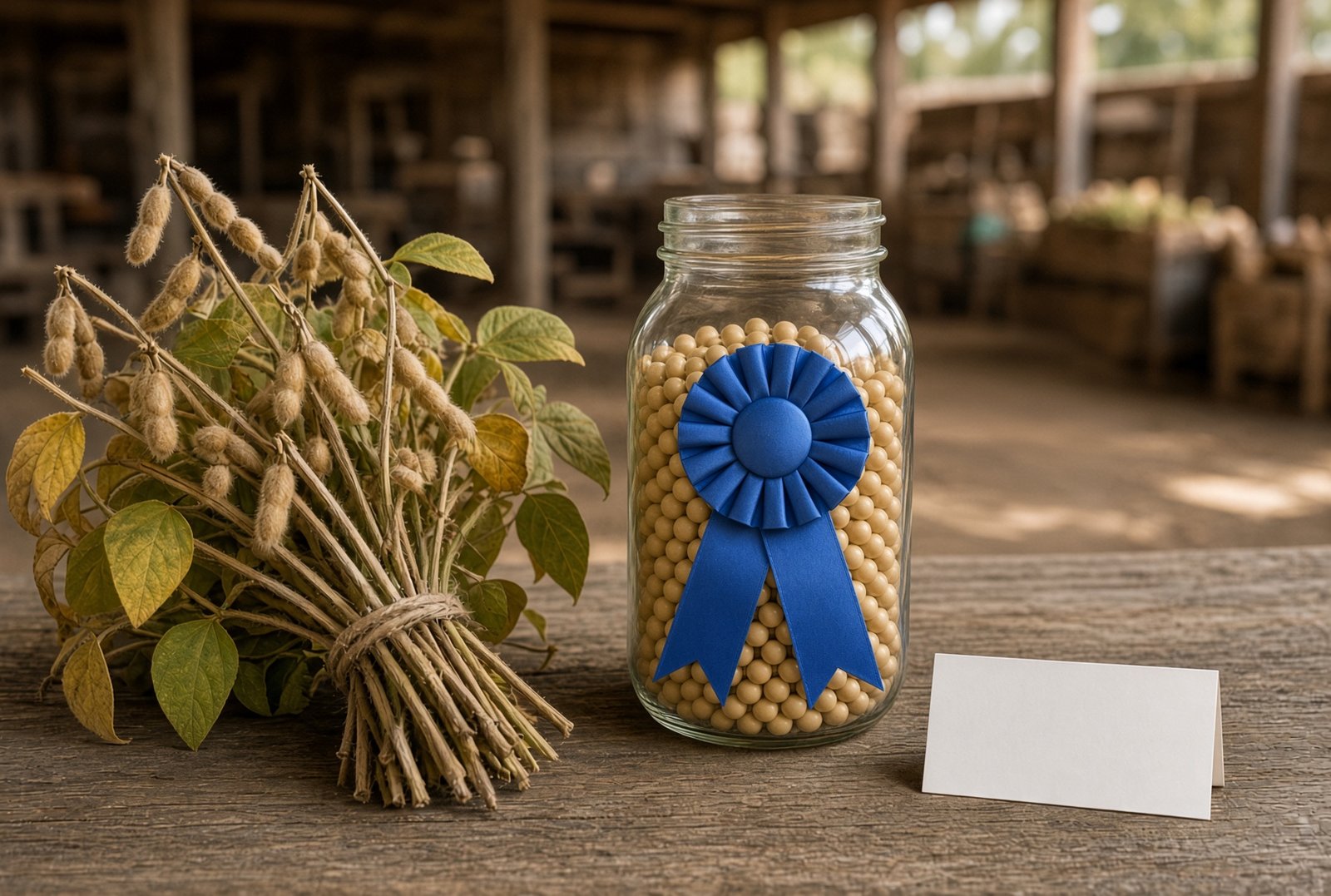
Classes and rules differ by county, so read your fair book first. Common soybean classes are a bundle or sheaf of whole plants and a quart or peck of clean beans. Judges usually look for:
- Uniform size and color — all beans the same variety, no mixed colors.
- Clean sample — no splits, cracks, stems, weed seeds, pod pieces or dirt. Sort by hand on a tray.
- Mature, dry beans — hard, with no green or shriveled beans.
- Plant bundles — plants pulled with roots intact (show nodules!), pods well filled, tied neatly, leaves removed if the rules say so.
- A complete entry card — variety, maturity group, planting date and anything else the fair book asks for.
Keep good records
Records are what turn a garden into a project. Log every date, activity, expense and observation. Use our free soybean project record sheet, which includes the yield formula, alongside your club's or chapter's official record book.
Yield contests and FFA CDEs
- Yield contests: many state soybean associations run yearly yield contests, and some have youth divisions. Check your state soybean association's website.
- FFA Agronomy Career Development Event: teams identify crops, weeds, seeds, insects and diseases and solve agronomy problems. Growing soybeans yourself is great practice for plant and seed ID.
- Proficiency awards: a well-documented soybean SAE can count toward FFA proficiency areas in crop production.
Careers that start with a soybean project
| Career | What they do |
|---|---|
| Agronomist / crop consultant | Help farmers choose varieties, scout fields and solve crop problems |
| Plant breeder | Develop new varieties with higher yield and better disease resistance |
| Seed sales representative | Match seed products to farms and run local plot trials |
| Extension educator | Run university research plots and teach farmers and youth |
| Grain merchandiser | Buy and sell grain, and follow reports like the WASDE |
| Food scientist | Turn soybeans into foods like tofu, soy milk and plant proteins |