Soybeans are a warm-season crop that's easy to grow in a garden bed, a large pot or a school garden. This guide covers what a backyard gardener or a teacher needs: picking seed, planting at the right time, care, and knowing when to harvest — whether you want edamame (green soybeans) or dry beans.
Quick facts
Plan your planting with the garden planner
Choosing seed: edamame or dry beans?
- Edamame (vegetable soybeans) are bred to be picked green and eaten. They have large, sweet beans. Look for them in garden seed catalogs and seed racks.
- Dry soybeans (field types) are what farmers grow. They're harvested when the plants are dry and brown, and the beans are used for tofu, soy milk, feed and oil. Their maturity group (MG) tells you how far north or south they fit — see our maturity group finder.
When to plant
Plant after your last spring frost, once the soil is at least 60°F at planting depth — usually one to three weeks after the last frost date. Cold, wet soil slows sprouting and invites seed rot. In most of the U.S., that's between early May and early June. Soybeans are sensitive to day length, so plants sown much later in summer flower sooner and stay smaller. Farm planting windows by region are in our planting timing guide.
Inoculant and root nodules
Soybean roots team up with soil bacteria (Bradyrhizobium japonicum) that form small round nodules and turn nitrogen from the air into food for the plant. If soybeans have never grown in your soil, coat the seed with a soybean inoculant (sold at garden centers) right before planting. Later in the season, dig up a plant and cut a nodule open: pink or red inside means it's working.
How to plant in a garden bed
- Pick a sunny spot with well-drained soil. Loosen the top 6–8 inches.
- Make rows 18–30 inches apart (or plant a block with plants 4–6 inches apart each way).
- Sow seeds 1–1.5 inches deep and about 2 inches apart. Firm the soil and water well.
- Seedlings appear in 5–10 days. When they have their first true leaves, thin to 3–4 inches apart.
- Mulch between rows once plants are a few inches tall to hold moisture and block weeds.
Growing in pots and containers
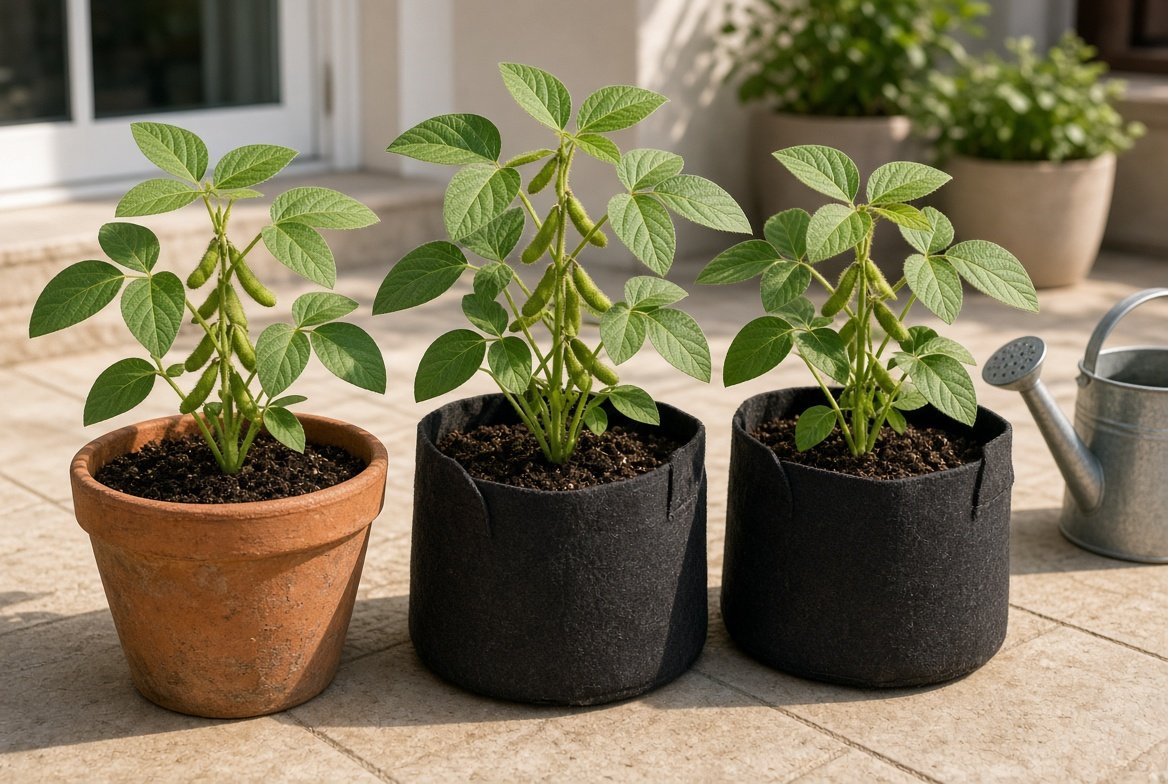
- Use a pot of at least 5 gallons with drainage holes, filled with potting mix (not garden soil).
- Plant 4 seeds per pot, then keep the strongest 2–3 plants.
- Pots dry out fast: check daily in summer and water when the top inch is dry.
- Put pots where they get 6–8 hours of direct sun.
Growing indoors at school
Soybeans sprout well in clear cups on a sunny windowsill — perfect for watching roots and the hook-shaped stem push up. To grow plants through to pods indoors, use a grow light about 2–4 inches above the leaves and a timer. Day length matters: on long days (16 hours of light) plants stay leafy longer, while on shorter days they flower sooner. That makes a great class experiment. Move plants outside after frost if you want a real harvest. Try the seed-in-a-bag activity first.
Water, weeds and pests
- Water: about 1 inch a week. Water matters most when plants flower and fill pods.
- Fertilizer: skip high-nitrogen fertilizer — it makes leaves, not beans. Nodules supply nitrogen.
- Weeds: keep the first 4–6 weeks weed-free; after that the plants shade the ground.
- Pests: rabbits and deer love young soybeans, so a fence helps. Japanese beetles chew holes in leaves; hand-pick them into soapy water. Stink bugs can damage pods late in the season. See our disease guide for leaf spots and root rots.
Growth stages to watch
Scientists name soybean stages with letters and numbers: VE (emergence), VC (first leaves), V1, V2, V3… (each new set of three leaves), then the reproductive stages R1 (first flower) through R8 (full maturity). The Soybean Journey walks through every stage, and the printable plant journal lets students track them week by week.
Harvest: edamame and dry beans
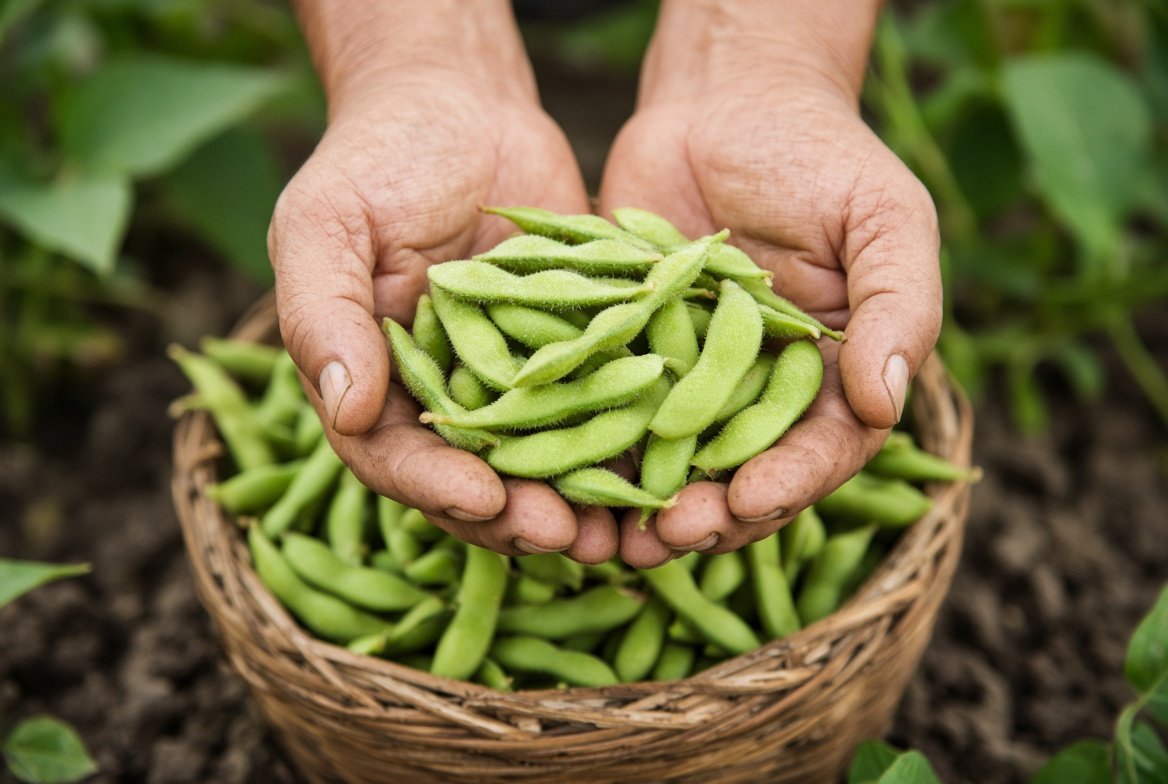
- Edamame: pick when pods are plump and bright green and the beans fill the pod (R6). Taste one cooked pod to check. The window is about a week before pods yellow. Refrigerate and cook within 2–3 days, or blanch and freeze.
- Dry beans: wait until leaves drop and pods turn tan and rattle (R8). Pull or cut the plants, finish drying under cover if needed, then shell. Store dry beans in a sealed jar.
Ready to cook? See easy soybean recipes.
Common problems
| What you see | Likely cause | What to do |
|---|---|---|
| Seeds never came up | Cold, wet soil; planted too deep; birds | Replant in warm soil at 1–1.5 in |
| Pale yellow young plants | No nodules yet, or waterlogged soil | Use inoculant next time; improve drainage |
| Lots of leaves, few pods | Too much nitrogen fertilizer, or too much shade | Skip nitrogen; give 6–8 hours of sun |
| Holes in leaves | Japanese beetles, bean leaf beetles | Hand-pick; healthy plants tolerate some leaf loss |
| Empty or flat pods | Drought at flowering or pod fill; stink bugs | Water deeply each week in summer |
| Plants flowered when tiny | Planted late (short days) or MG too early for your area | Plant on time; choose an adapted variety |
Frequently asked questions
How long do soybeans take to grow?
Most edamame varieties are ready to pick about 75–100 days after planting. Dry soybeans take about 100–130 days to reach full maturity, depending on the variety and how far north you live.
Can I grow soybeans in a pot?
Yes. Use a pot of at least 5 gallons with drainage holes and good potting mix, and keep 2–3 plants per pot in full sun.
Do soybeans need fertilizer?
Usually very little nitrogen. Soybeans make their own through root nodules. A soil test tells you if phosphorus, potassium or lime are needed.
Can I plant soybeans from the grocery store?
Whole dry soybeans from a grocery store may sprout, but you won't know the variety or how it's adapted to your area. Garden-seed edamame varieties are a more reliable choice.
When should I pick edamame?
When the pods are plump, bright green and the beans fill the pod — growth stage R6. Pick before the pods start to yellow; the window is only about a week.
Keep going
Sources: land-grant university extension guidance on soybean planting, growth stages and home-garden edamame; USDA WASDE (November 2026) for U.S. acreage and production.