These hands-on soybean activities work for classrooms, homeschool and clubs. Most need only a few dollars of supplies, and each one links to a free printable. Grade ranges are suggestions — adjust the questions up or down.
1. Seed in a bag
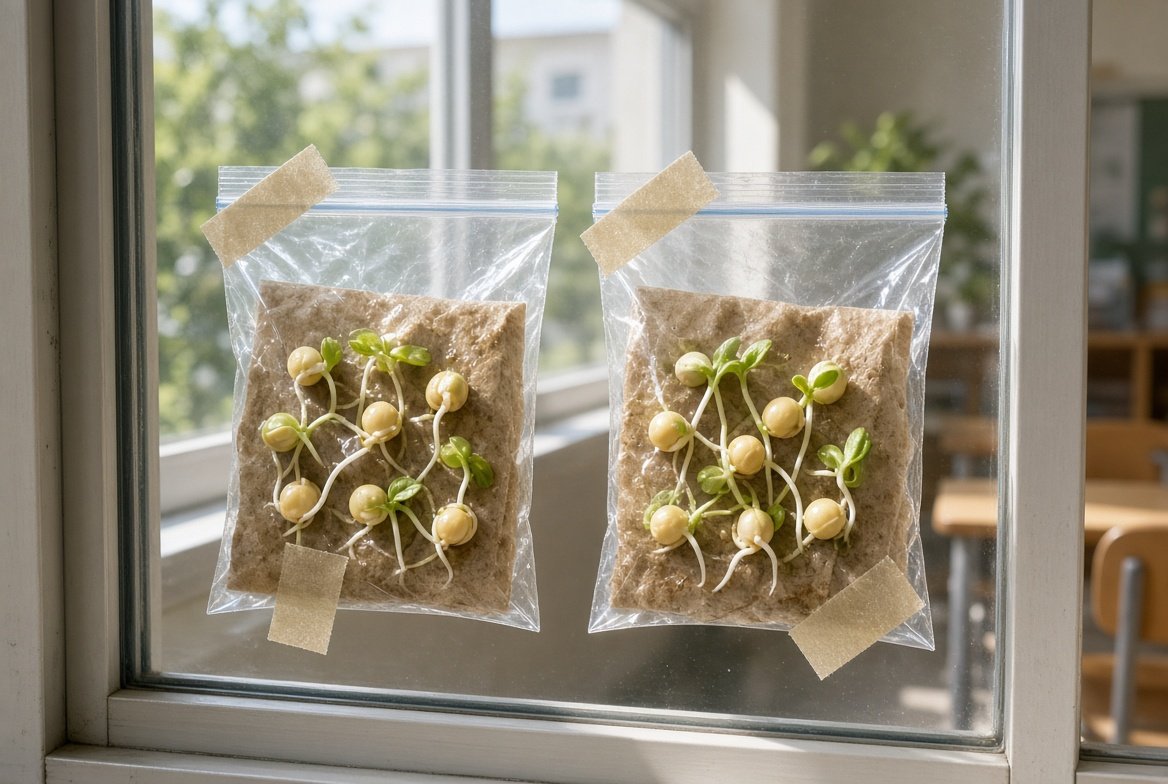
Watch a soybean sprout
You need: zip-top bags, paper towels, untreated soybeans, tape, water.
- Soak seeds in water overnight.
- Fold a damp (not dripping) paper towel into each bag and place 3–4 seeds on it.
- Seal the bag with a little air and tape it to a sunny window.
- Check every day: draw the root, the hook-shaped stem and the first leaves.
- After 7–10 days, plant the seedlings in cups of soil.
What students learn: what a seed needs to sprout (water, warmth, air), and the order roots and shoots appear.
2. Growth-stage journal
Track a plant from VE to R8
You need: potted soybean plants, a ruler, the plant journal printable.
- Plant soybeans in pots or the school garden.
- Each week, measure height, count sets of three leaves and name the stage (VE, VC, V1… R1… R8).
- Draw the plant on the drawing page.
- At the end, graph height by week.
What students learn: plant life cycles, measuring, graphing, and the stage names farmers and scientists use.
3. Root nodule dig
Find the plant's nitrogen factories
You need: a soybean plant at flowering (R1–R3), a trowel, a bucket of water, a plastic knife, a hand lens.
- Dig around the plant and lift the whole root ball — don't pull, or nodules break off.
- Swish the roots gently in water to wash off soil.
- Count the round nodules on the roots.
- Cut a few open: pink or red inside means the bacteria are fixing nitrogen; white or green means they aren't active yet.
- Compare plants grown from inoculated and uninoculated seed.
What students learn: symbiosis, the nitrogen cycle, and why farmers don't need to add nitrogen fertilizer to soybeans.
4. How many beans are in a bushel?
Estimation and multiplication
You need: dry soybeans, a kitchen scale, calculators, the worksheet.
- Weigh exactly 1 ounce of soybeans and count them.
- Multiply by 16 to get seeds per pound, then by 60 for seeds per bushel.
- Use 140,000 seeds per acre to estimate how many acres one bushel can plant.
- Use USDA's 53.3 bushels-per-acre forecast to see how many seeds one acre produces.
What students learn: estimation, multi-step multiplication and the scale of farming.
5. Products made from soybeans

Soybean scavenger hunt
You need: food labels, magazines or a walk around school and home.
- Explain that a crushed bushel becomes about 47 lb of meal (mostly animal feed) and 11 lb of oil.
- Students hunt for products that can contain soy: cooking oil, tofu, soy sauce, soy milk, salad dressing, crayons, ink, candles, foam, biodiesel.
- Sort finds into food, feed, fuel and industrial products.
- Older students: research why soybean oil use for biofuel has grown.
What students learn: how one crop becomes many products, and how farms connect to everyday life.
For older students, our November WASDE breakdown shows how much U.S. soybean oil now goes to biofuel.
6. Science fair ideas
- Inoculated vs. not: does seed inoculant change nodule count or plant height?
- Day length: plants under 16 hours of light vs. 12 hours — which flowers first?
- Planting depth: how does 0.5, 1.5 and 3 inches change emergence?
- Water stress: does skipping water at flowering change the number of pods?
- Soil temperature: germination speed in a warm room vs. a cool garage.
Keep everything else the same between groups, use at least 5 plants per group, and record results in the plant journal.
7. Market math with the WASDE (grades 9–12)
Every month USDA publishes a soybean "balance sheet": supply minus use equals ending stocks. Students can recreate it with real numbers from our November 2026 WASDE breakdown, calculate the stocks-to-use ratio (300 ÷ 4,614 = 6.5%), and discuss why lower stocks usually mean higher prices. The how to read the WASDE guide explains each line.
More resources
- Free soybean printables — coloring sheet, life-cycle cards, word search and more.
- The Soybean Journey — an interactive look at every growth stage.
- National Agriculture in the Classroom — searchable, standards-aligned lesson plans.
- Your state soybean board or council and county extension office — many offer classroom kits, speakers and farm visits.